
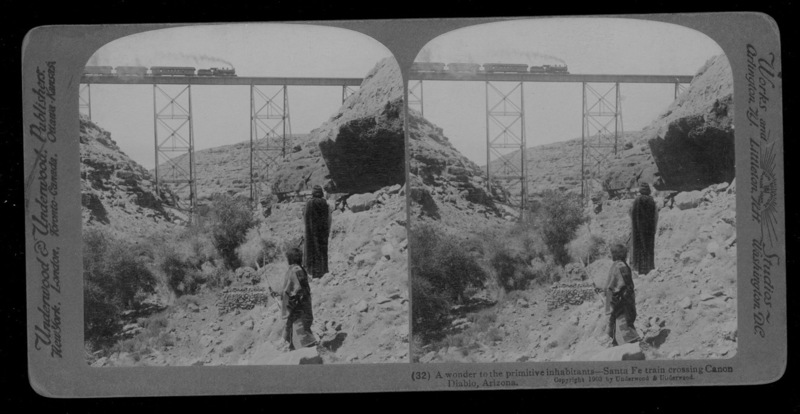
[Original title of the stereograph: “A Wonder to the Primitive Inhabitants – Santa Fe train crossing Canon Diablo, Arizona.” ]
The term primitive as it is used in reference to the indigenous subjects of image is offensive, but mostly the title is ironic. The image portrays two indigenous people, an older man and a young boy, walking in the direction of an impressive structure—a bridge on which a train is making its way across. They most likely did consider the train, or the bridge, or the train crossing the bridge to be a wonder; I won’t disagree. But are they more impressed with the technological developments of Westerners than Westerners are themselves? Probably not.
About the time this image was taken, the “Indian dens” decorating fad was taking hold in New York City and would eventually spread nationwide. Some of what was being transported in trains back East from the Southwest was items created by indigenous people for the tourist market. These included handwoven Navajo textiles marketed by traders as floor rugs, runners, portieres, and wall hangings. Woven textiles like the serape and cape worn by the man and boy in the image, but marketed for therapeutic or spirituality invoking home décor “to Euro-Americans as a way of satisfying their desires for stasis and comfort in the midst of traumatic and societal change.” (Wilkins, 78)
The opening up of the Euro-American tourist market to the American Southwest allowed indigenous makers to provide for their households, but the compensation received for their woven textiles and other handmade creations was far from fair, much less so than what would have been received before the disruption of the indigenous trade market, which happened decades earlier for Navajo people with their internment by the US government at Bosque Redondo. One of the factors encouraging the popularity of indigenous-made goods in this new tourist market is the same thing that drew people to “document” Native people with photographs and their stories and cultural knowledge with audio recordings and in written text was the fact that Westerners expected us and our culture to disappear or die off. This belief also, I’m sure, gave buyers or traders the rationale to pay indigenous makers far below what they would have paid anyone else.
Velma Kee Craig
September 2020
Note: Wilkins, Teresa J. Patterns of Exchange: Navajo Weavers and Traders. University of Oklahoma Press: Norman, Oklahoma. 2008.