
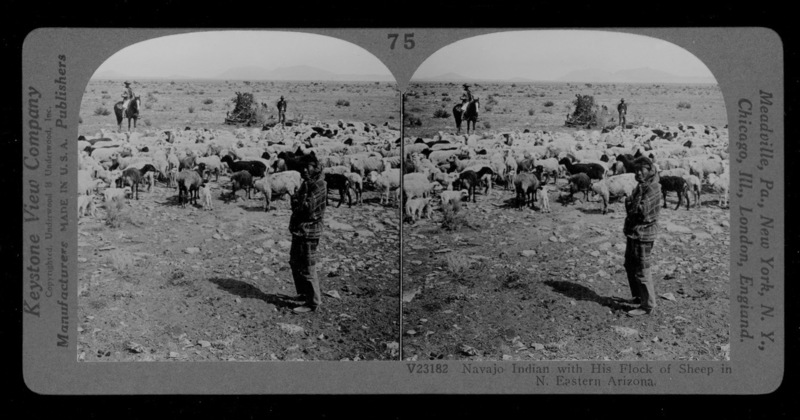
In my family, my mother’s generation was the last generation to herd sheep. Due to government policies, boarding school, and the relocation programs offered to Navajos, sheep herding was not a feasible way of earning money, in my mother’s case she chose to go to college in California in the late 1960s. My mother attended boarding school most of year, but she would jokingly say prior to attending school, her first job was working as a sheep herder at 5 years old. When my mother came home from school for summer, she and her siblings would be responsible for the flock and if any went missing, they were sent back out to find the missing sheep. I have always been fascinated by my family’s sheep herding stories, they were always humorous with a bit of sadness too.
The image shows a family herding sheep, after studying the image further, you can see the lambs mixed in with the flock, so it’s spring. The mountains in the distance look like the San Francisco Peaks. In the spring, during lambing season, it’s all hands-on deck and there needs to be more than one herder to keep an eye on the flock. The image shows three men spaced out around the flock. My mother remembers the work in herding during lambing season because lambs tend to fall asleep anywhere while their mother’s graze. Lambs can easily get separated from the flock and get lost; they are also vulnerable to predators that can creep in any time. As in the image, the herders will space out on horseback and on foot to watch over the lambs and keep an eye out for any predators. Lambs don’t always go out with the flock, there are times when the lambs are kept home while rest of the flock are taken out to graze.
Cheryl Begay-Mizell
September 2021