
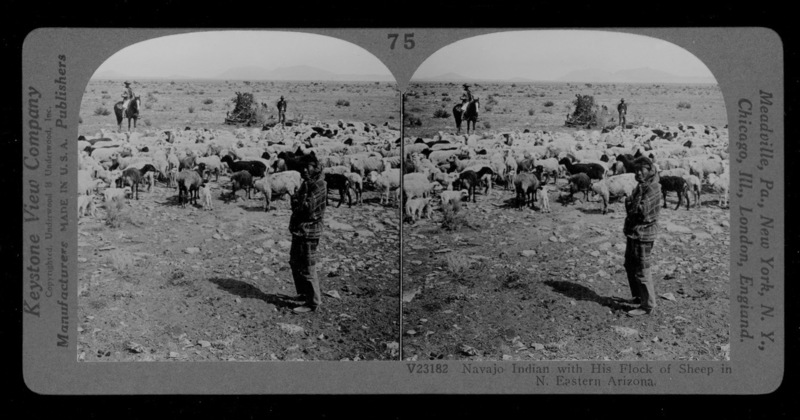
Churro sheep were brought to the Southwest in 1542 by Francisco Vasquez de Coronado. Churro were able to survive in arid conditions and many Navajos families raised large flocks before and after the Long Walk to Bosque Redondo (1863-1868).
Due to ill-informed federal government actions in 1933-1934 the Navajo Churro were almost completely wiped out during the Livestock Reduction. The reduction was in response to a drought, soil erosion, and too many animals overgrazing. It was devastating to Navajo livestock owners, mainly women. The livestock belonged to Navajo women and they were not consulted. Many of the elders refer to this as the Second-Long Walk. Since 1977, Dr. Lyle G. McNeal, Carnegie Professor and Sheep and Wool Specialist at Utah State University, now Professor Emeritus retired, founded and directed the Navajo Sheep Project (NSP). The mission of this non-profit was to protect into perpetuity, the Churro. It works to preserve an endangered historic breed, increase the value of textiles that Navajos weave, and scientifically evaluate and document the unique traits of this breed.
Today, Navajo weavers have more choices for sheep, raised primarily for food and wool. Things have changed and continue to evolve. Not all Navajo who have sheep keep Navajo Churro. As a fifth-generation Navajo tapestry weaver, I get asked, “How many sheep do you have”? I live in the city of Denver proper and do not own sheep. My family did not own sheep while I was growing up on the Navajo Nation in the 1970s. My grandparents, my aunts and uncles all had flocks and we received the wool from them for my and my family’s weaving. They raised mostly Ramboulliet, or mixed breeds. My Aunt Margaret Yazzie raised our family sheep but is now too elderly to manage. My family of weavers now rely on roving; wool bought from sheep producers from various breeds. We continue to process the roving into weft for our textiles. For our Two Grey Hills’ tapestries, we are able to spin a very fine, thread like weft and are not able to achieve a fine weft with Churro wool. We love the sheep and honor them for their gifts to us. They are still integral to our lives even if we choose not to raise them.
Lynda Teller Pete
June 2020