
History of Stereographs
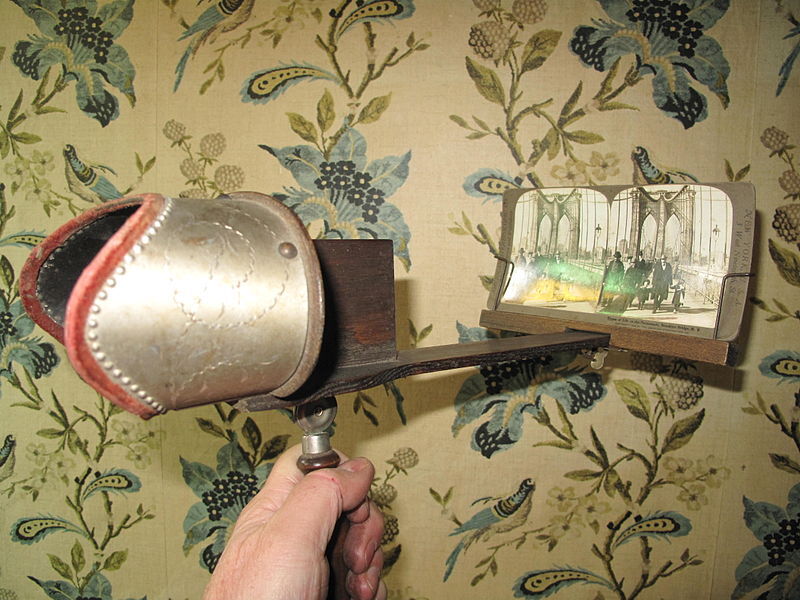
First appearing in the mid-nineteenth century, stereographs mimicked human vision by presenting two photos of the same subject side-by-side. One image is slightly extended to the right of left of the other. When viewed together with the aid of a stereoscope, they produce a three-dimensional effect. Most of the stereographs featured in this exhibit were published by one of the major American producers of stereographs, the Keystone View Company, between 1900-1930. This company was the only major publisher of stereographs in the world after 1920. Amateur photographer Benneville L. Singley launched the business in 1892. The large-scale, mass production company dispatched professional photographers to take pictures around the world. Based in Meadville, Pennsylvania, the company had a trade list of 8,000 titles by 1900 that were technically among the best produced. Between roughly 1912 and 1922, Keystone purchased the rights to several stereograph series from various other companies.
The height of the popularity for stereographs was between 1898 and 1906. The company began marketing boxed sets of stereographs to schools in this period, "selling... geographical and cultural views to enhance classroom pedagogy; these sets were often accompanied by texts [teachers' manuals] and maps - offering what at the time was a veritable multimedia experience." (Hack)
As products made possible by scientific principals and mechanical means, stereographs seemingly provided students and other consumers with enhanced visual knowledge and experience. Stereoscopy, marketers promised, would provide a technologically superior vision of the world, affirm national progress and Euro-American intellectual authority. At the same time, however, captions and guidebooks that accompanied the stereographs often blinded viewers. The required use of a stereoviewer to see the images confined individuals to a space conceived as natural but was framed by a subjective photographer’s eye. Most messages put forth by the Keystone View Company were framed by colonial presumptions about Native Americans’ inevitable demise and racial inferiority; these ideas conveyed the evolving story of the vanishing race.
Keystone Company ceased regular production in 1939, but continued to fill orders for stereographs until 1970.
The remaining 350,000 item archive of the company was acquired by the California Museum of Photography at the University of California, Riverside in 1977. Part of the archive, the Keystone-Mast Collection, has been digitized. It is accesssible through the Online Archive of California (OAC). The photographs in this collection are not the mass-produced cards; they are copy prints from the original negatives. Some of the images include those that were published and are featured on this website. A numbering code on each photograph gives some indication of whether it was published and by whom, but names of photographers are almost never noted.
Laura E. Smith
Sources:
William C. Darrah, The World of Stereographs. Gettysburg, PA: Darrah, 1977, p. 49-51.
Brian E. Hack, "Seeing Double: The Art of the Stereoview in Nineteenth Century America," The Art Gallery (now Kingsborough Art Museum), Kingsborough Community College of the City University of New York, April 5 - April 30, 2008. Web. Accessed December 16, 2009.
Judith Babbitts, "Stereographs and the Construction of a Visual Culture in the United States," Memory Bytes: History, Technology, and Digital Culture. Duke University Press, 2004.
Martha Sandweiss, "Photography and the American Indian," in Print the Legend: Photography and the American West. Yale University Press, 2002, p. 235.