
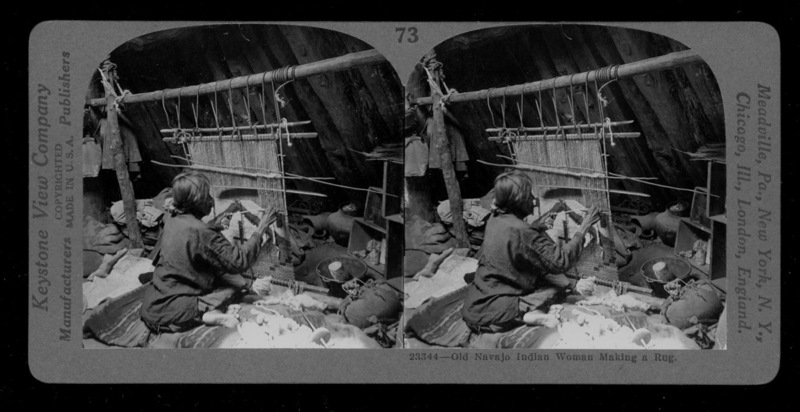
I like the loom construction. A common question I get from students is how were early looms constructed before the use of metal hardware became common? In this image, you can clearly make out that the loom’s top and bottom beams are secured to the side beams with rope or heavy-duty cord. In fact, every place I am used to seeing metal or plastic being utilized on a modern loom is instead secured with rope, twine, or some kind of cord or fabric strip.
It’s a treat for me to see the workspace of a Diné weaver from almost a hundred years ago. Her space looks so comfortable, with everything she needs not too far away. I’m looking at what she is weaving on the loom in comparison to the textile she is sitting on. The project on the loom looks like it is woven much more coarsely, with bulkier handspun weft, than the one spread out under her.
I assume the textile currently being woven and still on the loom is one she intends to sell. It looks like what is referred to as a pound blanket. These are usually woven with coarser wool so they would be heavier and also woven more quickly. Weavers were paid during this time according to the weight of the blanket, rather than design complexity or quality of the weave, which some might consider unfortunate.
I wonder if the weaver of the textile off the loom was someone else—someone related to her, from a previous generation maybe. If so, what inspiration does she absorb from it? How much meaning does it have for her? This is a beautiful image.
Velma Kee Craig
September 2020