
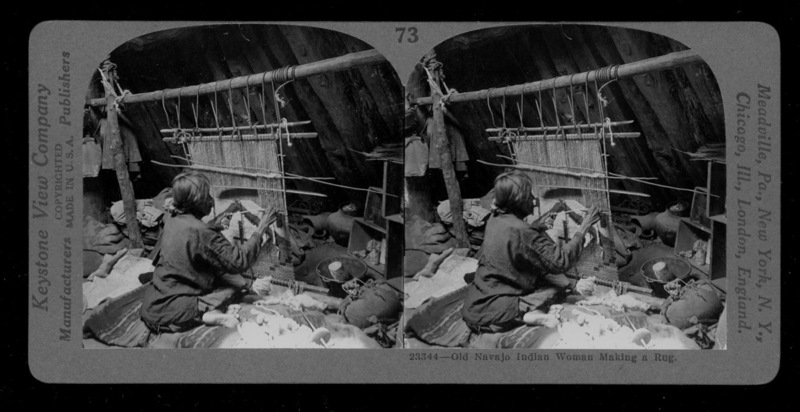
Before a Navajo weaver uses a weaving comb to pat down the first line of wool weft on a textile, she or he starts with prayers and songs. The process honors the acknowledgment to combine the universe, the environment and their family’s teaching so they can weave in harmony and the rug will provide for their family. Where one [Keystone View Company] sees a “primitive loom”, Navajo weavers place tradition, songs and prayers on making a textile on a loom. They use weaving tools, harvested from not-struck-by-lightning, natural fallen cedar, piñon or scrub oak branches and tree trunks, properly made to provide balance and strength. Where one [Keystone View Company] sees an “age-old occupation” of weaving, the weaver continues the proper beginning prayers; she sings as the loom is warped, employing the philosophy of duality of life; balance is being created by the female and male warps, and they are equal in every movement. The shed, heddle and batten inserted into the warps are representative of female and male lightening, thunder and rain. The weaver then washes, cards, and spindles the wool. After she begins to weave, she will still say prayers and sing as she is figuring out her patterns and which colors to use. I was taught this by my grandmother. She also taught me to never weave when I was angry or upset. She taught me that my weaving has a living soul and I have to respect that. Just like how people have their own spirits and can take on the emotions of others around them, so can a weaving. I was taught to be respectful and humble with my work. I’ve carried that forward to my children. Since the Navajo Nation is so big, I know every weaver has their own style and family traditions; but, this is what I was taught and what I truly believe. I take care of my weavings till they are ready to find a new home.
Barbara Teller Ornelas
June 2020